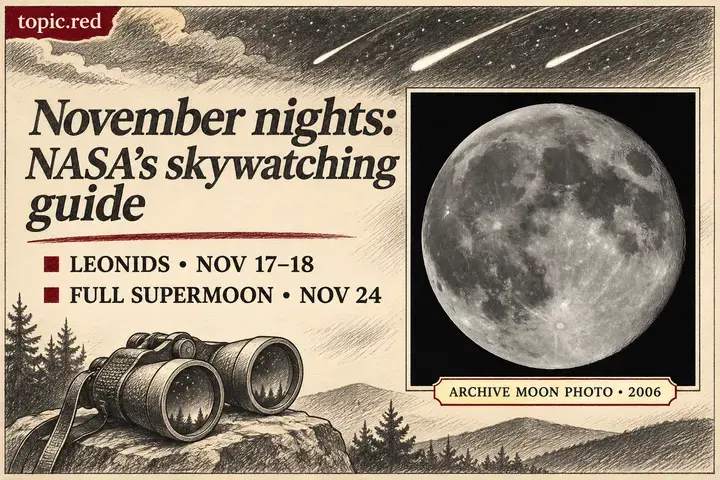
U.S. skywatchers planning an evening or early-morning outing have several dates to check in NASA’s newly released November guide: Taurid meteors early in the month, Mars near Jupiter in mid-month, and a full supermoon on November 24. Clear skies and a dark location will matter more than a packed observing schedule.
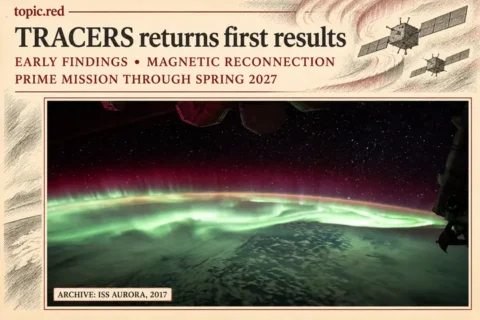
The first paper examines paired spacecraft encounters with Earth’s magnetic cusp from November 2025 through February 2026. Its analysis finds spatial variability dominates by at least a factor of two across the solar-wind conditions studied, while many encounters also contain time variability. NASA says the prime mission has been extended through spring 2027. These are preliminary research results, not a new operational storm-warning service.
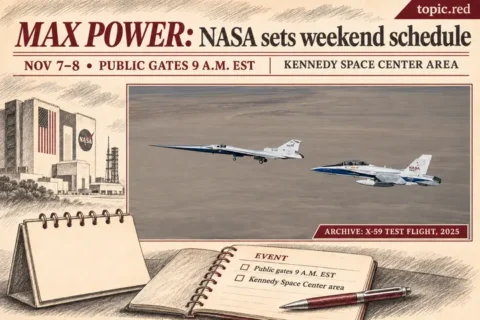
The MAX POWER programme runs November 6–8 on and near Kennedy Space Center; public weekend gates open at 9 a.m. EST. NASA lists its X-59 aircraft among the displays and schedules astronaut appearances across the weekend. A Moon Base news conference is scheduled for November 7 at 5 p.m. EST. Listed times remain subject to change.
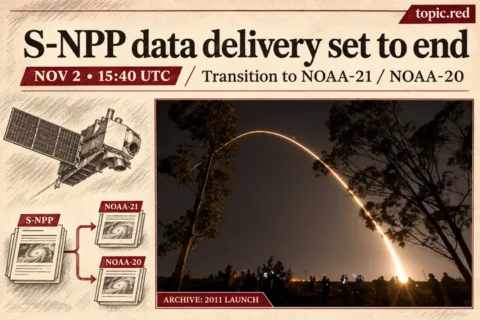
Update #3 sets the final cutoff at 15:40 UTC on November 2; an earlier notice carried a different time. All remaining S-NPP science products and high-rate direct broadcast are affected; this is a permanent cessation. NOAA identifies NOAA-21 as the primary replacement and NOAA-20 as secondary. Deorbit operations are planned for December.
NASA’s October 29 request seeks information on boosting, servicing or eventually disposing of Hubble. Companies have until 3 p.m. EST on November 30 to respond, according to NASA’s October 30 announcement. NASA anticipates that a mission would need to take place by 2032; its current reentry estimate is 2033–2034.
The agreement was signed in Tuscaloosa, Alabama. Potential work includes remote sensing and agricultural statistics. The agencies plan to examine data integration and analysis.
PIXL detected particles smaller than earlier on-site measurements resolved. Different target materials collected different particle sizes. NASA says the findings could inform suits, habitats and dust-removal procedures.
PACE compares leaf pigments repeatedly across broad areas. Early-October data showed colour shifting from parts of the Northeast toward the Midwest and Mid-Atlantic. GLOBE seeks ground observations to help check the satellite measurements.
Speaker registration closes October 26; general registration closes November 5. The November 6 meeting is virtual, free and requires registration. FDA will discuss lot-level tracking challenges and possible compliance flexibilities.
The rehearsal ran on a computer testbed at Johns Hopkins APL. Software and avionics worked with simulated camera, lidar and other sensor data. Further tests are planned on the actual flight system, including fault scenarios.
The sortie departed NASA Armstrong at Edwards on October 21. NASA reported a maximum Mach 1.4 and an altitude of 55,000 feet. The work assessed handling and aircraft systems following maintenance.