First TRACERS results begin separating where magnetic reconnection changes from when it changes
The first paper examines paired spacecraft encounters with Earth’s magnetic cusp from November 2025 through February 2026. Its analysis finds spatial variability dominates by at least a factor of two across the solar-wind conditions studied, while many encounters also contain time variability. NASA says the prime mission has been extended through spring 2027. These are preliminary research results, not a new operational storm-warning service.
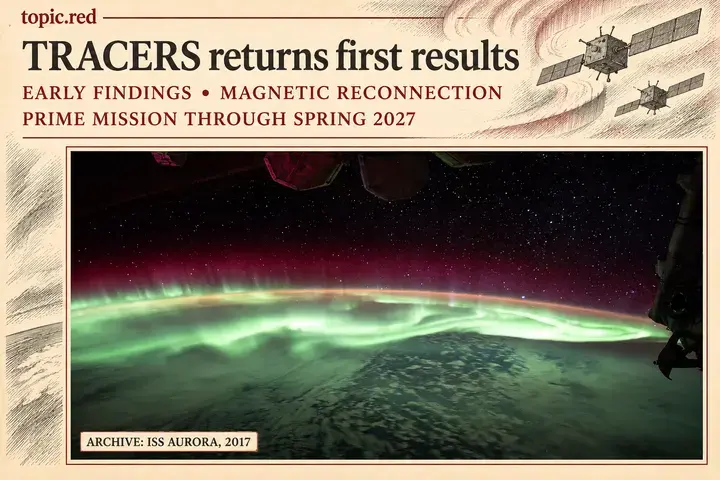
Early results from NASA’s TRACERS mission suggest that changes across space dominate over changes with time in the magnetic-reconnection encounters examined so far. The finding gives the U.S.-led research team an initial test of a central mission question, while leaving more observations to be collected.
News date: 2 November 2026 / Facts checked: 2 November 2026

Magnetic reconnection transfers energy when magnetic fields rearrange. A single spacecraft may have difficulty telling whether a changing observation reflects motion through different regions or a process changing over time. TRACERS uses closely spaced passes by two spacecraft to help distinguish those possibilities.
The paper, published October 29 in Journal of Geophysical Research: Space Physics, uses the mission’s ion-sensor observations. Its authors also report that most encounters classified as spatial include temporal variability, so the result is not a claim that time-dependent changes are absent.
NASA’s account says the extension, approved in September, allows observations through spring 2027. The mission is led from the University of Iowa, with contributions including the Southwest Research Institute in San Antonio and NASA’s Goddard Space Flight Center in Maryland.
The work addresses physical processes relevant to space weather. It does not establish a forecast for a particular storm, a present danger to U.S. power grids, or a proven improvement in warning accuracy. Additional observations will test how broadly the early pattern holds.